A pendant head is not automatically the right answer for every room, and a sidewall head is not a universal workaround for difficult pipework. By comparing the room geometry, ceiling, obstructions, discharge pattern, system design, and product markings, you can specify the correct sprinkler and avoid an unsafe substitution.
Key takeaways
- Use pendants for open, level ceilings with clear downward discharge.
- Use sidewalls when wall placement provides an unobstructed discharge path.
- Check sprinkler classification, temperature rating, K-factor, and hydraulic design.
- Inspect every delivered head for damage, markings, caps, and correct components.
Match the sprinkler to the room, ceiling, and discharge pattern
Choose a pendant for an open, reasonably level ceiling; choose a sidewall sprinkler when placing pipe above the ceiling is impractical and a suitable wall offers a clear discharge path. The choice depends on coverage geometry, not simply on a 15 mm or 20 mm connection or the same temperature rating.
| Option | Physical arrangement | Discharge and best fit |
|---|---|---|
| Pendant | Connected above the ceiling, with the deflector below or flush with the ceiling | Downward coverage for offices, shops, rooms, and open areas |
| Sidewall | Installed close to a wall, usually beneath the ceiling | Horizontal or half-pattern coverage for narrow rooms, corridors, bedrooms, and service spaces |
A pendant suits a flat ceiling with coordinated openings for pipes, lights, beams, and ceiling panels. A sidewall suits a room with no usable ceiling void, but its wall distance, spacing, deflector height, and permitted obstructions come from that model’s listing; it is not a shortcut around ducts, racks, signs, cable trays, or exposed beams.
Check the actual deflector elevation and spray pattern against the obstruction layout. A sloped ceiling, low ceiling, suspended ceiling, or irregular wall can make a seemingly convenient head ineffective, while a sidewall head may leave poor coverage at the opposite end of a wide room.
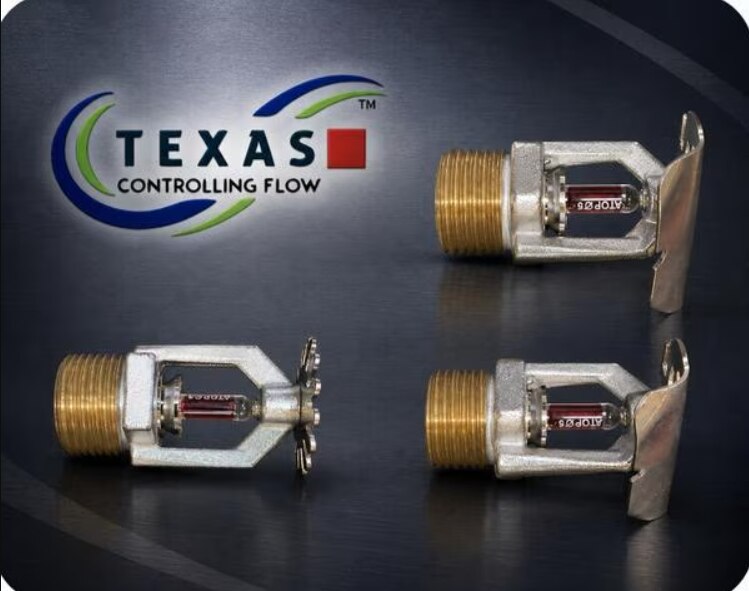
“texas pendant side wall sprinklers in mumbai” describes a search, not a technical classification. Identify the manufacturer and model, then verify its orientation marking, datasheet, approval or listing, and design data before specifying it.
Resolve pipework, ceiling, and obstruction problems before choosing
A beam, duct, cable tray, light fitting, or suspended ceiling can block the discharge pattern and leave an unprotected floor area.
Resolve the construction detail before selecting the head: a pendant needs its deflector at the listed elevation below or flush with the ceiling, while a sidewall head must sit near the wall at the manufacturer’s specified height and projection.
| Condition | Pendant sprinkler | Sidewall sprinkler |
|---|---|---|
| Usable ceiling void | Install from pipework above the ceiling; coordinate the deflector with panels and lights | Use only if the wall position and half-pattern cover the room |
| No practical ceiling pipe route | Rerouting pipework or a listed dry arrangement may be needed | Useful near an external or service wall, subject to listing and spacing |
| Beams, ducts, racks, or signs | Check obstruction rules at the actual deflector elevation | Check both the wall-side clearance and the horizontal discharge path |
| Narrow corridor or small room | Covers downward from the ceiling | Can cover along the room length, but wall distance and end limits still apply |
- Mark the proposed head, deflector elevation, wall distance, beam depth, duct width, and light locations on the reflected ceiling or coordination drawing.
- Compare those dimensions with the exact model’s datasheet and approval listing; nominal connection size and temperature rating do not make pendant and sidewall heads interchangeable.
- Ask a side wall sprinkler supplier for the manufacturer, model, orientation marking, spray pattern, obstruction limits, and installation data—not merely “sidewall” or “pendant.”
Check the sprinkler’s classification and hydraulic specification
A valid replacement must match the specified hazard classification, hydraulic design, orientation, temperature rating, connection and approval—not merely the pipe outlet diameter. A pendant sprinkler dealer in Mumbai should identify the exact manufacturer and model, then provide its datasheet, production date and traceability record.
| Detail | What to match | Failure if mismatched |
|---|---|---|
| Hazard classification | Light hazard, ordinary hazard, extra hazard, storage or special application | Coverage limits, discharge and minimum pressure may be wrong |
| K-factor | The approved design value, using Q = K√P | A different K-factor changes required flow and pressure |
| Temperature rating | The specified rating for the ambient temperature and heat exposure | Premature operation or delayed activation |
| Orientation and finish | Pendant or sidewall, concealed or exposed, and the specified finish | The listing may not cover that installation |
| Connection | Thread type and nominal connection size | The head may not seal or fit the branch pipe |
| Approval | Exact model, orientation, finish and service under the project requirement | A mark on another model proves nothing |
Check whether the design uses wet-pipe, dry-pipe or preaction service, and confirm the sprinkler’s permitted coverage, spacing, wall distance and obstruction rules. Sidewall data cannot be transferred automatically to a pendant layout.
- Ask for the approved hydraulic calculation or design density, minimum operating pressure and flow at each remote sprinkler.
- Confirm the governing requirement, such as the specified Indian Standard, consultant specification, insurer condition, UL Listing, FM Approval or BIS documentation.
- Reject a substitute if its approval, K-factor or temperature rating differs unless the fire-system designer recalculates and accepts it.
Use the project design basis, not room dimensions alone
A defensible quotation starts with the project design basis, not a room length and width. For a fire fighting sprinkler purchase in mumbai, send the supplier enough information to calculate coverage, discharge, compatibility, and approval status rather than asking only for a pendant or sidewall head.
1. State the occupancy and hazard: light hazard, ordinary hazard, extra hazard, storage, or a special application.
2. Provide ceiling height, room dimensions, ceiling construction, slope, and the intended coverage area.
3. Attach reflected-ceiling and obstruction drawings showing beams, ducts, lights, cable trays, partitions, and wall clearances.
4. Identify the service as wet pipe, dry pipe, or preaction, and state the ambient temperature range.
5. Specify the hydraulic design requirements, including K-factor, design density, remote-area flow, minimum pressure, and available water supply.
6. Give the connection details: thread standard, inlet size, orientation, wrenching feature, finish, and matching escutcheon.
7. State the temperature rating, response type, quantity, replacement model, and whether the sprinkler is for new work or an existing system.
8. Name the required approval, such as UL Listed, FM Approved, or BIS-marked, against the project specification.
If you compare a texas fire sprinklers supplier in mumbai, give every bidder the same brief. Navkar Enterprises -Texas Valves (India) can help check whether the offered model, approval, production date, and traceability match the design rather than treating “Texas” as compliance evidence.
Related product
 | Fire Fighting Valves pendant type.... side wall type... View product → |
Inspect the delivered heads and prevent installation failures
A delivered box is not proof of compliance. Before installation, compare every sprinkler with the purchase order, approved drawing, and manufacturer’s current datasheet; a pendant substituted for a specified sidewall head can leave part of the room outside the tested discharge pattern.
1. Check the label on each carton and head for the exact manufacturer, model, orientation, K-factor, temperature rating, finish, connection size, and production date. Record the batch or serial traceability information.
2. Match the approval document to that exact model, orientation, finish, and service. UL Listed, FM Approved, BIS-marked, or other documentation is useful only when it satisfies the project specification and the consultant, insurer, or authority requirement.
3. Inspect glass bulbs, frames, deflectors, threads, and coatings. Reject heads with cracked bulbs, bent deflectors, damaged threads, corrosion, missing identification, or packaging damage.
4. Confirm that the box includes the specified escutcheons, guards, and installation parts. Do not accept a decorative concealed residential head for an industrial hazard, or a wet-system head for dry or preaction service.
5. Before water enters the system, verify spacing, wall distance, ceiling position, obstruction clearances, and the listed temperature range against the approved layout. Keep spare heads in a proper spare-sprinkler cabinet with the correct wrench.
A quotation request for a fire-fighting sprinkler purchase in Mumbai, or to a side wall sprinkler supplier, becomes defensible when it names these details rather than saying only “pendant” or “sidewall.” Search terms such as “Texas” identify neither approval nor model.
Frequently asked questions
When should you choose a pendant sprinkler instead of a sidewall sprinkler?
Choose a pendant for an open, reasonably level ceiling with clear downward discharge. Choose a sidewall sprinkler when ceiling pipework is impractical and a suitable wall provides an unobstructed discharge path.
How do pipework, ceilings, and obstructions affect sprinkler selection?
Resolve ceiling voids, beams, ducts, lights, fans, storage, and pipe-routing constraints before selecting the head. These features can block the spray pattern or require additional sprinklers.
Which sprinkler specifications must you check before purchase?
Check the sprinkler type, orientation, temperature classification, response characteristic, nominal connection, K-factor, discharge pattern, pressure range, listing or approval, and hydraulic design requirement.
Why are room dimensions alone insufficient for sprinkler layout?
The project design basis also controls hazard classification, allowable spacing, coverage area, ceiling height, obstruction rules, water demand, and the hydraulic calculation.
What should you inspect when delivered sprinkler heads arrive?
Confirm the model, orientation, temperature marking, K-factor, connection, approval marking, finish, protective cap, threads, glass bulb or fusible element, and packaging condition before installation.
Keywords