A butterfly valve does not become safely open or closed merely because its handle has moved. You need to confirm the disc position, control the rate of movement, account for pressure and flow, and verify that the valve and flanges suit the service. By following the cycle below, you can operate the valve without confusing isolation with throttling or treating PN 16 as a universal 16-bar guarantee.
Key takeaways
- Rotate the disc approximately 90 degrees from parallel to across the pipe bore.
- Use intermediate positions for controlled flow, not as a substitute for a rated control valve.
- Check flange alignment, disc clearance, stem orientation, and seat condition before cycling.
- Match PN 16 pressure rating, materials, testing documents, and dimensions to the project.
How the stem and disc create the quarter-turn cycle
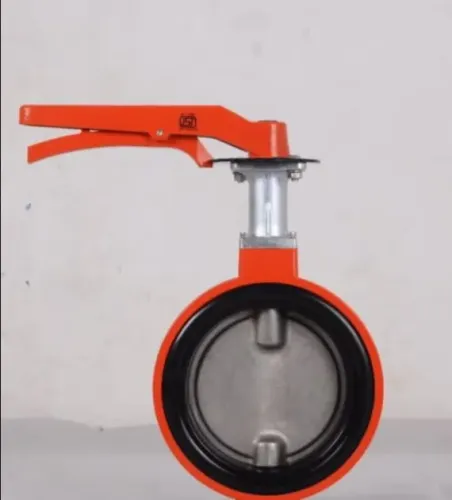
A fully open cast iron butterfly valve moves to shutoff when its actuator rotates the stem and attached disc through approximately 90 degrees. The disc starts parallel to the pipe bore, where it offers the least obstruction, and finishes across the bore, where its edge compresses the resilient seat to block flow.
The quarter-turn sequence is:
- At full open, align the handle or gearbox indicator with the pipeline. Confirm the disc is actually parallel to the bore; an incorrectly assembled stem or indicator can display the opposite position.
- Turn the stem gradually through the quarter-turn. The stem transfers torque directly to the disc, rotating it across the flowing medium.
- At intermediate angles, the disc restricts the passage and creates a pressure drop. Use this position for throttling only within the manufacturer’s permitted range.
- At full shut, place the disc across the bore and let the seat seal around its edge. Do not force the actuator beyond its specified stop.
Leaving the disc partly open for extended service increases turbulence, wear, noise, vibration, and seat erosion. A butterfly valve is primarily an isolation device, not a substitute for a characterized control valve.
Cast iron butterfly valve PN 16 working depends on the medium and temperature; PN 16 alone does not prove suitability for steam, hot oil, hydrocarbons, or chemicals. This stem-and-disc movement defines cast iron butterfly valve operation, but the seat and pressure-temperature rating determine whether the cycle is safe.
Opening sequence: from closed position to full flow
Safe cast iron butterfly valve operation starts with checks, not a forceful turn. Before moving a closed valve against line pressure, confirm that the valve, seat, flanges, and actuator suit the line’s pressure and temperature.
1. Confirm the downstream pipe, pump, vessel, and relief path are ready to receive flow. Keep people clear of flanges, drains, and moving actuator parts.
2. Check that the handwheel, gearbox, or actuator is firmly mounted and that the stem turns without binding. Remove transport locks, but do not remove guards while the line is pressurised.
3. Read the pressure gauge on both sides when available. Verify that the PN 16 rating applies at the actual fluid temperature; pressure class alone does not establish safe service at every temperature.
4. Inspect the position indicator, then compare it with the disc position. A wrongly assembled stem or indicator can show “open” while the disc still blocks the bore.
5. Crack the disc open slowly, using the handle or actuator control. Pause as pressure and flow begin, then watch for leakage, abnormal noise, vibration, or a sudden pressure drop.
6. Continue the quarter-turn to the required position. At full flow, the disc should lie approximately parallel with the pipe bore and the indicator should show fully open.
Opening too quickly can create a pressure transient, especially in a long, high-head line with little trapped air. Stop and investigate if the actuator stalls or the flange, stem, or seat leaks.
Throttling and shutoff: choosing the correct stopping point
Use an intermediate disc angle only within the manufacturer’s permitted throttling range; do not treat a resilient-seated butterfly valve as a general-purpose control valve. A partly open disc accelerates the medium through a restricted passage, increasing pressure loss and creating noise, vibration, cavitation, seat erosion, or unstable flow.
| Position | Correct use | What can go wrong |
|---|---|---|
| Fully open | Isolation valve with the disc aligned to the bore | A misaligned disc still restricts flow and increases loss |
| Intermediate | Temporary flow adjustment within the stated throttling range | Repeated near-closed operation can erode the seat and disc |
| Fully closed | Isolation after the disc reaches the specified closing stop | Stopping short causes leakage; over-travel damages the seat |
For shutoff, complete the quarter-turn smoothly and confirm the actuator reaches the valve manufacturer’s specified closed stop. Do not force the actuator against the disc, pipeline, or gearbox. Set adjustable travel stops from the valve’s closing procedure; an incorrectly set stop can leave the disc several degrees open or compress a resilient seat excessively.
- Reduce movement as the disc approaches closed.
- Check the position indicator against the actual disc position; an incorrectly assembled indicator can show “closed” while the bore remains partly open.
- Confirm leakage against the specified ISO 5208 test classification, test direction, and medium. “Tight shutoff” alone does not define an acceptable leakage rate.
- If the valve will not seal, stop cycling it. Check for debris, damaged lining, incorrect stop adjustment, or a pressure differential that the actuator cannot overcome.
Installation checks that determine whether the cycle is safe
Before the first quarter-turn, confirm that the installed valve matches the pipe, service, pressure, and actuator; a PN 16 marking alone does not make operation safe.
1. Check the piping. Match DN, flange standard, PN 16 drilling, bolt-circle dimensions, raised-face arrangement, and face-to-face length. Align and support the pipe without forcing the valve between flanges. Confirm that bolts, welds, or pipe scale cannot touch the disc through its full 90-degree travel.
2. Check pressure. Compare the line pressure and operating temperature with the valve’s pressure-temperature table, not just the PN 16 label. Isolate and depressurise the line before correcting alignment, removing bolts, or inspecting the disc.
3. Check material compatibility. Record the body grade, seat or liner material, shaft seals, and the actual medium. Water service does not qualify a valve for steam, hot oil, hydrocarbons, or chemicals; steam requires an explicit steam rating and compatible seat.
4. Check shutoff evidence. Obtain the leakage-test certificate and identify the ISO 5208 leakage class, test medium, and test direction. “Tight shutoff” without those details does not establish the permitted leakage rate.
5. Check the actuator. Compare breakaway, running, seating, and differential-pressure torque with the actuator output, including packing friction and deposits. Cycle the valve slowly and verify that the indicator shows the actual disc position: parallel to the bore means open, across it means closed.
A handwheel that stalls, a disc that rubs, or an indicator that disagrees with the disc is a stop condition, not a commissioning detail.
What to verify when sourcing a valve for a Mumbai project
For a cast iron butterfly valve PN 16 in Mumbai, verify the paperwork and nameplate before comparing price or dispatch time. Mumbai supply does not change acceptance criteria. Obtain the exact body grade, DN, flange standard, seat material, shaft arrangement, pressure-temperature table, operating torque, and test records for the offered valve.
Ask the supplier for:
- A model-specific datasheet showing dimensions, PN 16 rating, materials, medium, and temperature limits.
- A nameplate photograph showing manufacturer, model, DN, PN, body material, and serial or batch number.
- A leakage-test certificate and hydrotest or inspection record linked to that serial or batch.
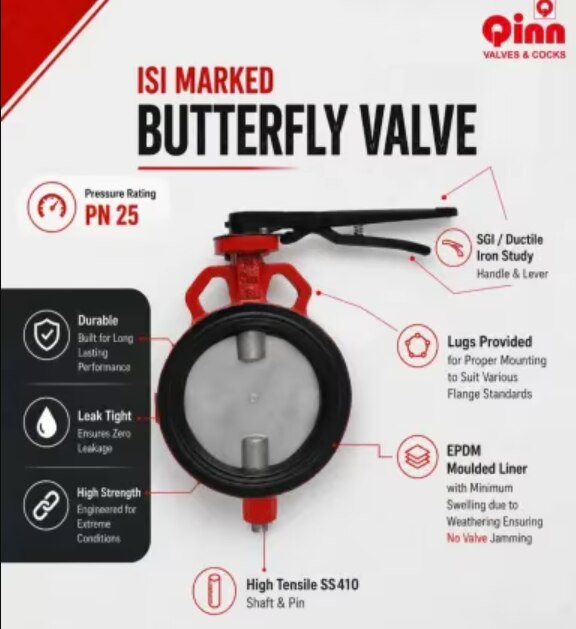
- For an ISI cast iron butterfly valve, the applicable Indian Standard, BIS licence number, scope of licence, covered sizes, product type, and manufacturing location.
- For fire-fighting service, separate recognised or listed approval and the specified supervisory indication arrangement.
- Confirmation that the seat, shaft seal, and body rating suit water, steam, hydrocarbons, or chemicals—not merely “PN 16.”
| Marking or description | What it proves | What to verify |
|---|---|---|
| QINN cast iron butterfly valve | A commercial product family or listing | Exact model, materials, DN, rating, and test results |
| ISI mark | BIS conformity under a licensed standard | Standard number, licence scope, size range, and factory |
| PN 16 | Nominal pressure class | Pressure-temperature rating for your medium |
Navkar Enterprises -Texas Valves (India) can help match the supplied model, certificates, and markings before a Mumbai project accepts the valve.
Related products
 | CAST IRON BUTTERFLY VALVE CAST IRON BUTTERFLY VALVE PN 16 ISI QINN CAST IRON BUTTERFLY VALVE PN 16 ISI QINN LEVER OPERATED View product → |
 | BUTTERFLY VALVES CI BUTTERFLY VALVES KINS PN 16 ISI MARKED ₹1 LEVER OPERATED SIZE 40 MM TO 300 MM PN 16 ISI TEMPRATURE 50 DEGREE NITRILE / EPDM RUBBER CI DISC & SS DISC View product → |
Frequently asked questions
How does a cast iron butterfly valve complete its working cycle?
The actuator rotates the stem and attached disc through approximately 90 degrees. The disc lies parallel to the bore when open and crosses the bore against the resilient seat when shut.
What happens during the opening sequence?
Starting from shutoff, the actuator turns the stem so the disc moves away from the seat. As the disc approaches alignment with the pipe bore, flow resistance falls and the valve reaches full open.
Where should you stop the valve for throttling or shutoff?
Stop at an intermediate angle when you need to restrict flow, using the actuator position indicator and the process requirement. Rotate fully to the closed stop for shutoff, then confirm that the disc contacts the seat without excessive force.
Which installation checks affect safe valve operation?
Confirm that the flanges are aligned, the gasket does not project into the bore, the disc has clearance throughout its travel, the stem and actuator are accessible, and the pipe is supported independently.
What should you verify when sourcing a PN 16 valve for a Mumbai project?
Verify the DN and face-to-face dimensions, PN 16 pressure and temperature limits, cast iron grade, seat and disc materials, flange drilling, actuator type, inspection records, and delivery availability.
Related products
 | CI BUTTERFLY VALVES CI BUTTERFLY VALVES WAFER TYPE PN 16 ISI PN 16 RATING ISI View product → |
 | BUTTERFLY VALVES WAFER TYPE CAST IRON BUTTERFLY VALVE QINN MAKE PN 16 ISI View product → |
Keywords