Large pipelines often require a valve that provides practical isolation without adding excessive weight, space requirements, or operating complexity. Butterfly valves are widely used for this purpose because their basic design is compact and adaptable to many industrial piping arrangements.
For engineering companies, contractors, utilities, and industrial facilities in Mumbai, understanding their operating characteristics makes it easier to determine when a butterfly valve is appropriate.
What Is a Butterfly Valve
A butterfly valve contains a circular disc mounted on a shaft inside the valve body. Rotating the shaft changes the position of the disc.
When opened, the disc aligns more closely with the direction of flow. When closed, it rotates across the flow path and works with the seat to provide shut-off.
Because it uses rotational movement rather than a long linear stem movement, the valve can be relatively compact.
Why Butterfly Valves Are Used
One of the major practical advantages is their size-to-weight relationship.
Compared with some alternative valve designs at larger nominal diameters, butterfly valves can require less installation space and may be easier to integrate into crowded piping layouts.
Depending on the valve design and service requirements, applications can include:
- Water distribution systems
- HVAC and cooling-water lines
- Industrial utility pipelines
- Process-water installations
- Fire-water networks
- Compatible fluid-handling systems
The specific valve materials, seat, disc, pressure class, and operating mechanism must still match the application.
Wafer and Lug Type Designs
Buyers commonly encounter wafer and lug-type butterfly valves.
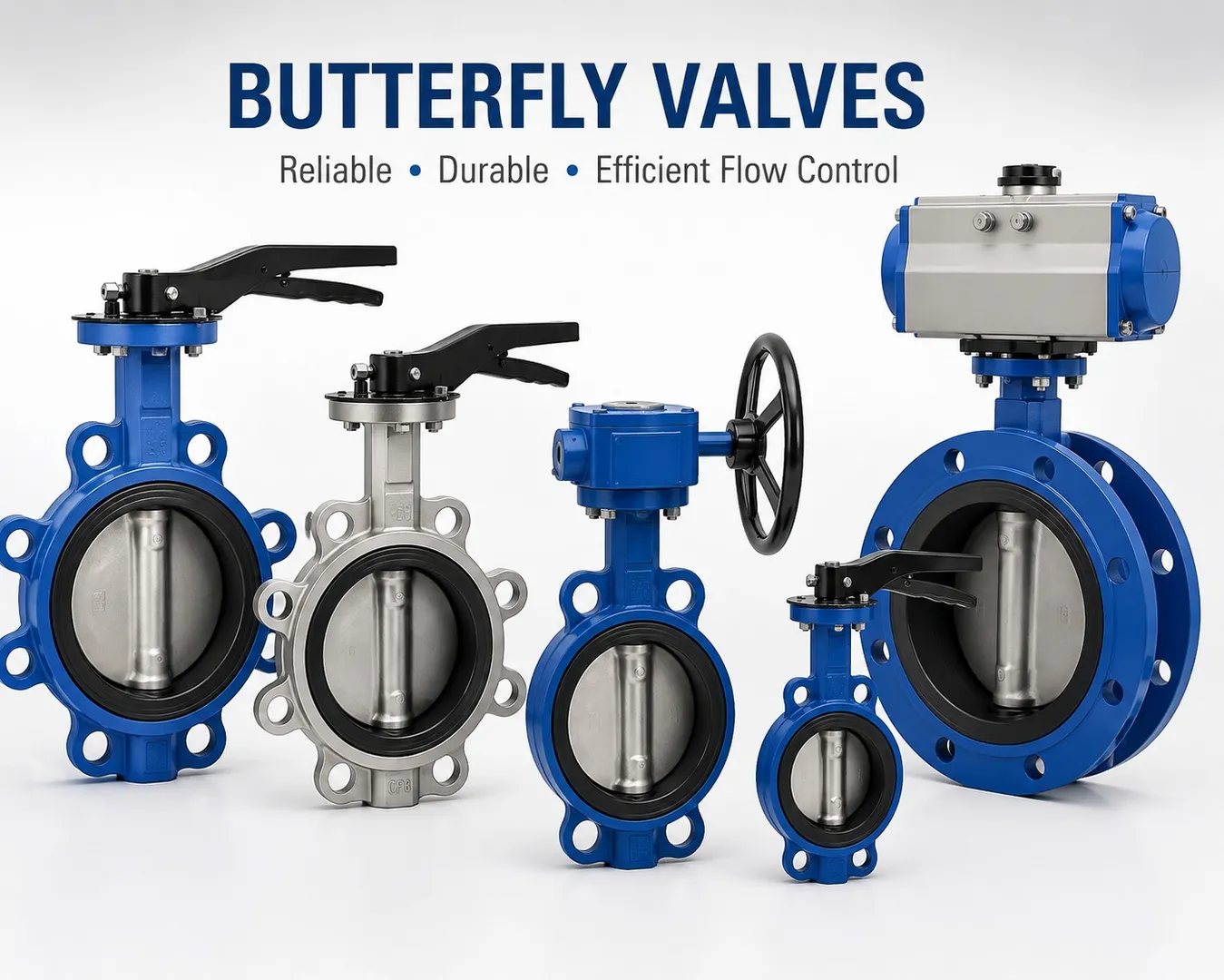
A wafer valve is installed between pipeline flanges and is generally compact. A lug-style body incorporates threaded or designed connection points around the valve body, providing a different installation arrangement.
Neither configuration should automatically be considered better. Selection depends on piping design, maintenance requirements, flange arrangement, and operating conditions.
Manual and Actuated Operation
Butterfly valves can be operated using handles, gearboxes, or suitable actuators.
Smaller valves may use simple lever operation, while larger valves can benefit from geared operation because of the torque required. Automated industrial processes may use pneumatic or electric actuation where remote or controlled operation is required.
Facilities across Mumbai and Maharashtra should consider future operating requirements at the specification stage rather than deciding on actuation after piping installation.
A Better Way to Specify Butterfly Valves
When discussing requirements with an industrial valve manufacturer or supplier, provide the nominal size, medium, pressure, temperature, flange standard, preferred body and disc materials, seat requirements, and operating method.
Companies such as Navkar Enterprises - Texas Valves can use these parameters to identify configurations aligned with the intended application.
Butterfly valves can be highly practical components, particularly in larger piping systems. Their effectiveness, however, comes from selecting the correct construction and operating arrangement for the service rather than treating every butterfly valve as interchangeable.
Keywords