Butterfly valves are widely used across industrial facilities because they provide efficient flow control while remaining compact and cost-effective. Their simple design, quick operation, and ability to handle large volumes of fluid make them suitable for many pipeline systems.
Industries across Mumbai frequently install butterfly valves in water, chemical, HVAC, and manufacturing applications where dependable shut-off and flow regulation are required.
What Is a Butterfly Valve?
A butterfly valve controls fluid flow using a circular disc mounted on a rotating shaft.
When the handle or actuator turns, the disc rotates either:
- Parallel to the flow for full opening
- Perpendicular to the flow for complete shut-off
- Partially open for flow regulation
This quarter-turn operation allows fast and convenient control.
Advantages of Butterfly Valves
Several features make butterfly valves popular across industries.
Compact Design
Their lightweight construction requires less installation space than many other industrial valves.
Quick Operation
Only a 90-degree rotation is required to open or close the valve.
Cost-Effective Solution
Butterfly valves generally cost less than many larger gate or globe valves while providing reliable performance.
Low Maintenance
With relatively few moving components, maintenance requirements remain minimal.
Suitable for Large Pipelines
They are especially effective in medium and large-diameter piping systems.
Common Types
Different operating conditions require different valve designs.
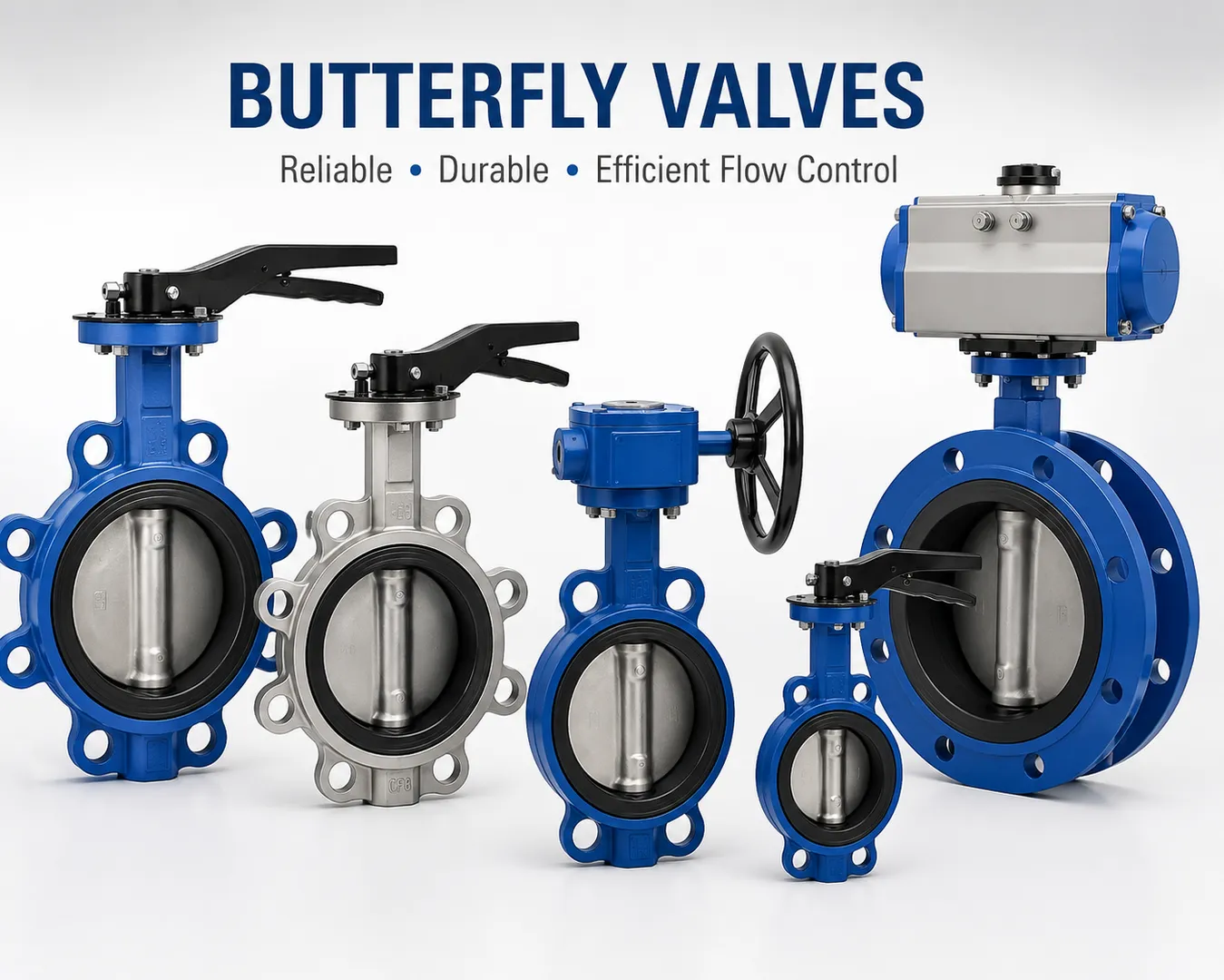
Wafer Butterfly Valve
Designed for compact installations and commonly used between flanges.
Lug Butterfly Valve
Allows one side of the piping system to be disconnected without affecting the opposite side.
Double Flanged Butterfly Valve
Suitable for larger industrial pipelines requiring secure installation.
Actuated Butterfly Valve
Operated using electric or pneumatic actuators for automated process control.
Industries That Commonly Use Butterfly Valves
Applications include:
- Water treatment plants
- HVAC systems
- Fire protection systems
- Marine installations
- Chemical processing
- Food manufacturing
- Power plants
- Paper mills
Their flexibility makes them suitable for numerous industrial environments.
How to Select the Right Butterfly Valve
Important selection factors include:
- Operating pressure
- Working temperature
- Pipeline diameter
- Media compatibility
- Manual or automated operation
- Seat material
- Disc material
Matching the valve specification to the application improves efficiency and service life.
Signs That a Valve Needs Replacement
Routine inspections help identify potential problems before failures occur.
Watch for:
- Persistent leakage
- Difficult operation
- Damaged seals
- Excessive vibration
- Corrosion
- Reduced flow efficiency
Replacing worn valves early helps avoid costly downtime.
Choosing the Right Supplier
Industrial buyers often evaluate manufacturers based on product quality, engineering support, available sizes, and compliance with industry standards. Companies such as Navkar Enterprises - Texas Valves (India) offer butterfly valves suitable for various industrial applications across Mumbai and Maharashtra.
Selecting the correct butterfly valve ensures reliable operation, lower maintenance, and improved pipeline efficiency for years to come.
Keywords